Europe’s bio-based industries generate increasing amounts of data, yet fragmented infrastructures and limited digital integration restrict the uptake of Artificial Intelligence.
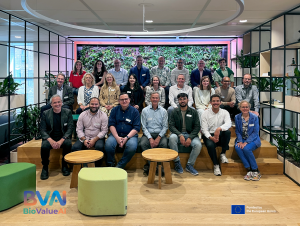
These challenges are at the centre of BioValueAI – Digital Innovations for Circular Bioeconomy, a four-year Horizon Europe project that officially began with its Kick-off Meeting in The Hague on 10 and 11 June 2026.
Coordinated by Wageningen Research, BioValueAI brings together 14 organisations working across research, industry, pilot facilities, technology development and social innovation.
During the two-day meeting, partners aligned on the project’s mission, five industrial use cases, implementation approach and first steps through dedicated sessions, breakout discussions and partner exchanges.
BioValueAI will combine Artificial Intelligence, digital twins and advanced data analytics to support circular and climate-neutral bio-based value chains. Its work is centred on five interconnected industrial use cases.
Cacao Valorisation will focus on using cacao pulp and husk in high-value non-food applications. An AI database will integrate Near-Infrared sensor data with traceability data, while AI-based prediction algorithms will help determine suitable uses for specific cacao batches.
Bio-based Coatings will apply AI and digital twins to support the development of paints, varnishes and chemical construction products using bio-based raw materials.
Precision Fermentation will use AI to analyse fermentation and downstream-processing data, support monitoring and optimise bio-based production systems.
Hemp Chain Intelligence will apply AI and digital technologies to harvest monitoring, retting-period forecasting, fibre extraction, biomass classification and quality assessment.
Biorefinery Feedstock Optimisation will use AI-driven analytics to identify and valorise organic feedstocks from the agri-food and beverage industries in the Iberian Peninsula.
Across the five use cases, BioValueAI will develop and validate AI models, digital twin approaches, reusable AI components, sustainability-related tools and guidelines for AI adoption in the bio-based sector.
The project follows a lean multi-actor approach involving industry, researchers, policymakers, citizens and civil society. Ethical, legal and social aspects will be considered from the outset, alongside transparency, fairness, data protection, trust and societal acceptance.
BioValueAI will also develop a Business Model Playbook to support the uptake and replication of project results.
The consortium includes Wageningen Research, EV ILVO, ATB-Bremen, reframe.food, Hyler BV, einzA Farben GmbH & Co. KG, VCG.AI GmbH, L. Pernía SA, Bio Base Europe Pilot Plant VZW, HOGENT, the Royal Danish Academy, Universität Innsbruck, the Czech University of Life Sciences Prague and CluBE – Cluster of Bioeconomy and Environment of Western Macedonia.
BioValueAI’s journey has now begun, bringing together digital innovation, circular bio-based value chains and responsible AI.