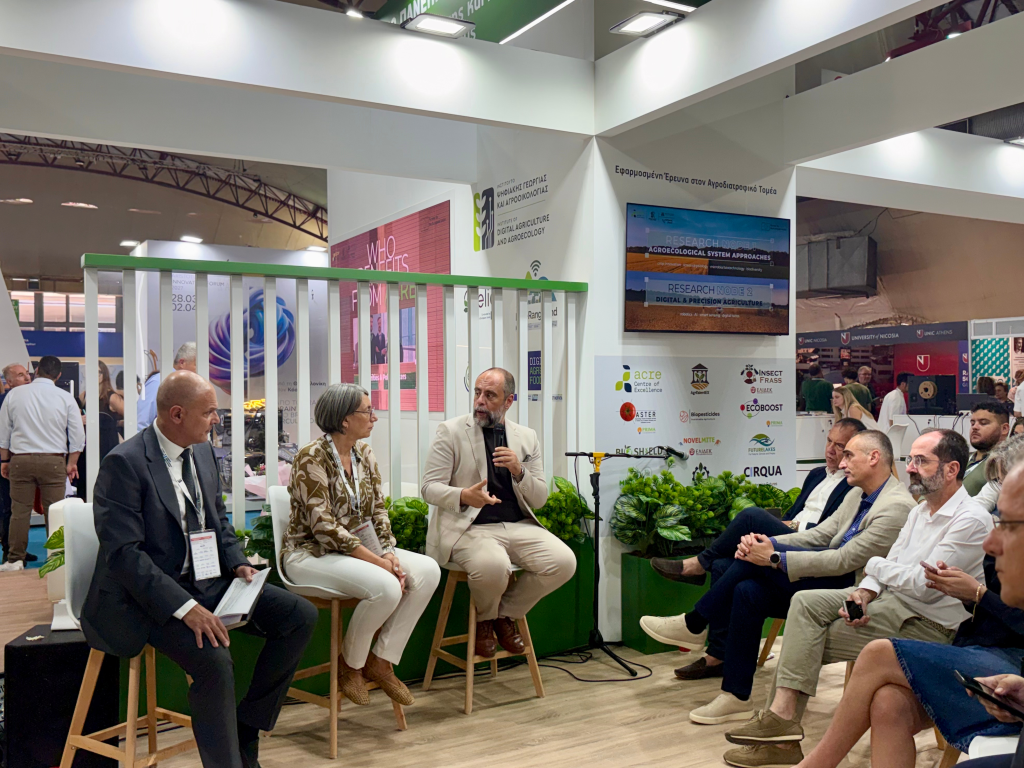
The vision and objectives of ACRE – Agrifood Climate Resilience Excellence Centre were presented on Sunday, 6 September, during the 90th Thessaloniki International Fair, at the event “The Agriculture of Tomorrow: Scientific Excellence and Digital Innovation for Resilient, Competitive and Sustainable Production.”
The six-year European project is coordinated by Democritus University of Thrace, with Wageningen University & Research and reframe.food as partners. Its aim is to develop an internationally recognised Centre of Excellence for climate resilience in agrifood.
More than €35 million in European, national and regional resources are foreseen to support ACRE’s development, covering research, equipment and the necessary infrastructure. This includes €15 million in European funding, approximately €16.5 million in national and regional funding, as well as €3.6 million for new building infrastructure.
From research to solutions for producers
The event brought together Maria Michalopoulou, Professor and Rector of Democritus University of Thrace, Dr. Ir. Sjaak Wolfert, Senior Scientist and Theme Ambassador for Digital Innovation in Agri-Food at Wageningen University & Research, and Grigoris Chatzikostas, Partner at reframe.food.
Maria Michalopoulou highlighted ACRE’s ambition to generate new knowledge, strengthen human capital and bring research results closer to practice:
“Through this initiative, which we are particularly excited about and which we will begin implementing from the start of 2027, we aim to generate new knowledge through our collaboration, develop a new generation of researchers able to address contemporary challenges in digital agriculture and agroecology and, ultimately, deliver solutions for producers.”
She also stressed the importance of strengthening trust between universities and producers:
“What I would like to see change in the coming years is the level of trust producers have in the results generated by the university and in how useful these results can be as solutions to the challenges they face.”
Agroecology, digital agriculture and real-world testing
ACRE’s research activities will focus on two main pillars: agroecology and digital and precision agriculture.
Technologies including Artificial Intelligence, IoT, robotics, remote sensing and digital twins will be combined with research on sustainable production systems, while Living Labs across Eastern Macedonia and Thrace will enable solutions to be tested under real-world conditions.
The scale of the initiative is also reflected in its targets. ACRE aims to involve 200 researchers in skills development and mobility activities, support 1,000 producers through advisory services and engage more than 100 companies through cooperation or services provided by the Centre of Excellence. The project also foresees the creation of 10 start-ups and 6 spin-offs, while aiming to retain 80% of the PhD candidates and postdoctoral researchers trained through the initiative within the regional research ecosystem.
Building long-term capacity through international collaboration
From the side of Wageningen University & Research, Dr. Ir. Sjaak Wolfert underlined that the collaboration goes beyond knowledge transfer and aims to build long-term capacity and a strong ecosystem of people and organisations.
“In practice, Wageningen will help ACRE build stable and long-term capabilities, rather than simply transfer expertise or resources. The train-the-trainer approach means that we want to work side by side with Greek researchers, so that knowledge and experience can multiply their impact far beyond the duration of the project.”
Looking ahead, he added:
“Over the next two or three years, we should move from planning and capacity building towards much more tangible results. We will jointly develop the Centre of Excellence, establish Living Labs, launch collaborative research activities and train a new generation of researchers and innovation professionals. At the same time, we want to connect ACRE with European networks.”
He also highlighted the importance of turning research excellence into real-world adoption:
“A Centre can produce excellent science, but success ultimately depends on whether producers, businesses and policymakers actually use the knowledge and innovations being developed. A Centre of Excellence is not only about excellence in research, but also excellence in collaboration.”
Connecting research with the market and society
Referring to reframe.food’s role in connecting research with the market and supporting the exploitation of ACRE’s results, Grigoris Chatzikostas noted:
“Our goal is to help research results reach the market and create real value for society and the economy through appropriate business models, collaboration with companies and the exploitation of innovation. At the same time, we want to build trust within agricultural communities, activate producers as multipliers of technology and create the conditions for Greek researchers abroad to see ACRE as a meaningful opportunity to return and participate.”
ACRE aims to become a point of connection between scientific excellence and the real needs of production, the market and society, creating an ecosystem that brings researchers, producers, businesses and policymakers closer together.